Services

Five defined services

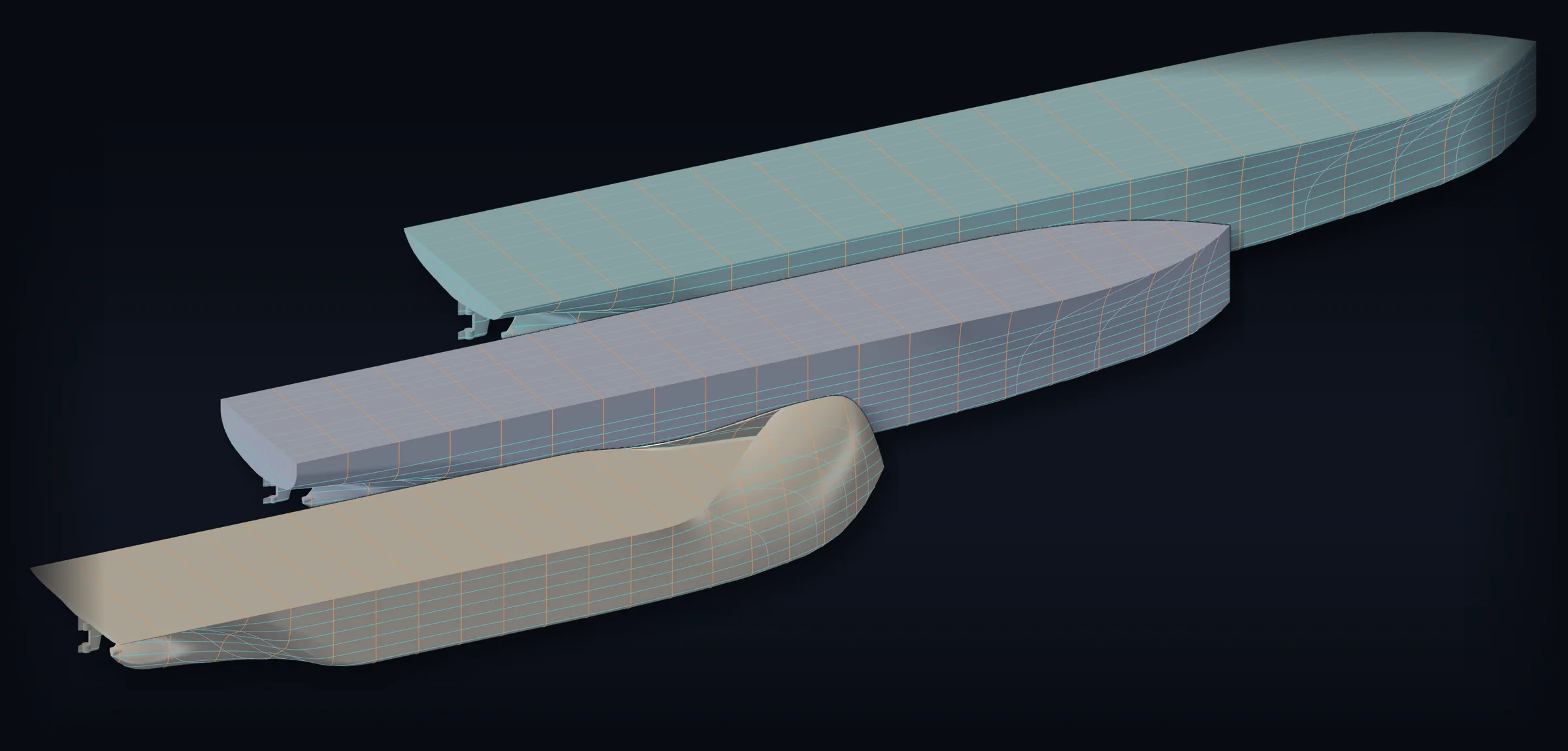
Propulsion shafting is the lead service. Each service has a defined scope, method and deliverable, and can be taken up on its own or with the others. Where machinery, piping and the shaft line affect one another, they are analysed on one model. The fifth, a 3D hull with viscous CFD and the wake, is a premium service taken on after a feasibility review.

01 · Lead service

Propulsion shafting systems

A complete engineering assessment of a propulsion shaft line, from main engine to propeller, produced from one geometry: engine and propeller matching, alignment, bearing lubrication, vibration and bearing duty.

  • Engine and propeller matching
  • Alignment, lift-off and influence coefficients
  • Stern tube and line bearing lubrication
  • Torsional, axial and lateral vibration
  • Bearing duty and comparative wear
  • Propeller geometry and offsets for the manufacturer (beta)
Full scope

02

Machinery and piping systems design

Design, integration and upgrading of shipboard auxiliary machinery: pumps, heat exchangers, refrigeration plant, air compressors and diesel generators, and the piping systems that serve them.

Full scope

03

Customised design or analysis

Calculation or design directed at one machine or one defined question: performance verification, uprating, damage investigation, replacement selection, or work no standard scope covers.

Full scope

04

Digital tools and AI integration

Development of computational tools for marine engineering: simulation software built on stated physics, measurement and data systems, and machine learning, including models run on your own hardware, applied where it improves on a conventional method.

Full scope

Service 01 in detail

Specialist shafting analyses

Each analysis within the propulsion shafting service has its own page: what it establishes, a worked example on the reference line, what is delivered and what it needs. They are taken up singly or together, always on one model of the vessel.

Shaft alignment analysis

Bearing reactions, slopes, lift-off and influence coefficients for the hot and cold conditions, with chock heights or offsets for installation.

Torsional vibration analysis

Natural frequencies, order crossings, shaft stress against class limits and barred speed ranges, on a mass-elastic model of the complete train.

Axial and whirling vibration

Axial modes against blade-rate excitation and lateral whirling with bearing coefficients from the film solution, in one rotor model.

Stern tube bearing analysis

Film thickness, edge loading, lift-off speed and comparative wear for water- and oil-lubricated stern tube bearings, straight or slope bored.

Propeller and engine matching

Where the propeller absorbs the engine power across the operating range, with light-running, fouling and weather margins set out.

Propeller geometry and offsets

Blade geometry, offset tables and section drawings for the manufacturer, with mass and inertia for the shafting calculations.


Service 01 · lead service

Propulsion shafting systems

A complete engineering assessment of a propulsion shaft line, with the main engine, shafting, bearings and propeller treated as one system, for a newbuilding, a sister vessel, a repair or conversion, or an installation showing elevated bearing temperature, abnormal wear-down or a vibration complaint in service. The deliverable is one shaft-line model and the results that model supports.

What the study covers

  • Engine and propeller matching. Where the propeller absorbs the engine’s power across the operating range, the light-running margin, and the margin left for hull fouling and weather, set against sea-trial data corrected to ISO 15016 where it is available.
  • Alignment. Bearing reactions, slopes and relative misalignment across the governing conditions; lift-off; influence coefficients in the form used to set chock heights; comparison against jacking and gap-and-sag records.
  • Lubrication and bearing duty. Oil-lubricated white metal and water-lubricated stern tube bearings; film thickness, pressure and mixed-lubrication duty at the misalignment the alignment produced; comparative wear for a straight and a slope-bored bush.
  • Vibration. Torsional, axial and lateral response of the same rotor, with engine-order and blade-rate crossings, and bearing coefficients taken from the same film solution.
  • Propeller. Geometry, offset table and section drawings for the manufacturer, a strength screening, and the mass and inertia carried into the alignment and vibration calculations. An in-house tool in beta release: examples and scope.

What is delivered

  • The model, with every input labelled as measured, supplied or assumed.
  • Result tables and plots for each condition.
  • Chock heights or bearing offsets where the scope extends to installation.
  • Comparison against any measurement, reported as a discrepancy.
  • A statement of open items and what would close them.

Service 02

Machinery and piping systems design

Design, integration and upgrading of shipboard auxiliary machinery, together with the piping that serves it. The scope may be a single machine, a complete system, or the machinery space as a whole, at the newbuilding stage, during conversion, or as a retrofit to an operating vessel.

Machinery

  • Pumps. Seawater, central and jacket cooling, bilge, ballast, fire and general service, fuel and lubricating oil transfer, cargo service. Selected on duty point, head, efficiency and driver rating.
  • Heat exchangers. Central, jacket water, lubricating oil and charge air coolers and condensers, sized to the plant heat balance.
  • Refrigeration and air conditioning. Provision rooms, refrigerated cargo spaces and accommodation, with the circuit that rejects the heat.
  • Compressed air. Starting and service compressors, receiver capacity for the required number of starts, dryers and distribution.
  • Diesel generators. Rating and number of sets against the electrical load balance, load sharing, cooling, combustion air and exhaust.
  • Other plant. Separators, boilers and exhaust gas economisers, hydraulic power packs, steering gear and deck machinery services.

Piping systems

  • System definition. Piping and instrumentation diagrams, schematics, line lists, and valve and equipment schedules.
  • Hydraulic design. Line sizing to velocity and pressure-drop limits, system head curves, NPSH available against required, and erosion-corrosion velocity limits by pipe material.
  • Services covered. Stern tube lubrication and cooling, fuel oil, lubricating oil, LT and HT cooling water, seawater, bilge and ballast, starting and service air, steam and condensate, hydraulics.
  • Flexibility and supports. Thermal expansion and pipe stress between hull structure and machinery that grows as it warms; expansion joints, anchors and guides.
  • Materials and integrity. Selection and galvanic compatibility, wall thickness, pipe class, joint details, hydrostatic and tightness testing.
  • Arrangement. Routing drawings fit for fabrication, with hull penetrations, supports, drainage, venting and access resolved.

Systems integration

  • Heat balance. Cooling capacity across the plant at the operating profiles the vessel actually runs, not at the design point alone.
  • Demand balance. Electrical load and compressed air demand, including starting transients and the worst credible simultaneous demand.
  • Shared services. Where one machine loads another through a shared service, and where redundancy is nominal rather than real.
  • Shaft-line interface. Where seating stiffness, thermal growth, tank loading or a pipe support alters the hull deflection the bearings see.

Upgrading and retrofit

  • Revised duty. Capacity increase, change of duty or replacement, assessed against the systems that remain unchanged.
  • Carrying capacity. Whether the existing piping, pumps, cooling and electrical supply can carry the new duty, and what must change if they cannot.
  • Seating and connections. Foundation and connected piping for the loads and thermal movement of the replacement unit.
  • Yard deliverables. Modified diagrams, arrangement drawings, calculation records, and a commissioning and test schedule.

Service 03

Customised design or analysis for marine machinery

Calculation or design directed at one machine, one system, or one defined question, where a standard scope does not apply. The machine is identified, the duty is stated, the acceptance criteria are agreed in advance, and the calculation is written so the decision it supports can be traced to its inputs.

Typical engagements

  • Performance verification. A machine below its rated duty, with the machine, the system around it and the measurement itself separated as causes.
  • Uprating and modification. A capacity increase or change of duty, and the limit that then governs, whether thermal, hydraulic, structural or electrical.
  • Damage and failure investigation. A failed component against the loading it actually saw, including loads the original design did not anticipate.
  • Replacement and selection. Equivalence of a proposed unit against the original duty, envelope, connections and the services available on board.
  • Vibration and noise. A machine, its seating or its connected piping, against ISO 20816 or the criteria stated in the specification.
  • Structural and thermal. Foundations and seatings, pressure-retaining parts, supports, and thermal growth and its consequences.
  • Specialised work. A one-off machine, a modification, or an analysis the other services do not name.

Machinery covered

  • Pumps. Duty, head and flow, suction conditions and cavitation margin, driver selection, and the system served.
  • Refrigeration plant. Capacity, the spaces or cargo served, refrigerant and circuit arrangement, and the cooling medium.
  • Compressors. Air or gas duty, stage arrangement, receiver sizing, and the consumers that depend on the supply.
  • Diesel generators. Output, the switchboard served, load acceptance, and the relation to other sources of power on board.
  • Heat exchangers, separators, boilers. Thermal and hydraulic duty, fouling allowance, and the conditions the unit must hold.
  • Shafting components. Couplings, thrust arrangements, stern gear and seals, against the shaft-line model where one exists.

Every customised engagement is defined in writing before work begins: the question to be answered, the input data, the method and standards to be applied, the acceptance criteria, and the form in which the result will be issued.


Service 04

Digital tools and AI integration

Development of computational tools for marine engineering: simulation software built on stated physics, systems that acquire and reduce measured data, and machine learning, including language and vision models run on the client's own hardware, applied where it improves on a conventional method. The work ranges from a single solver to a delivered application with its database and installer.

Engineering simulation software

  • Stated physics. Solvers built from the governing equations, not assembled around a component nobody can inspect.
  • Domains. Structural, hydrostatic, hydrodynamic and rotordynamic formulations, and the coupling between them.
  • Verification. Checked against closed-form solutions, published benchmarks and measurement, with the comparison reported rather than assumed.
  • Regression tests. A result that changes announces itself, instead of being discovered in a report months later.
  • Provenance. Figures and the numbers quoted beside them produced by the same run, so a document cannot disagree with itself.

Naval architecture computation

  • Hydrostatics and stability. Form calculation over the range of draught and trim, intact stability, and longitudinal strength.
  • Motion response. Behaviour in regular and irregular seas, including coupled degrees of freedom and non-linear damping.
  • Operational envelopes. Limits for lifting, ballasting and loading, expressed in terms an operator can work to.
  • Declared validity. Every tool states its assumptions and the range over which its answers hold.

Measurement and data systems

  • Acquisition pipelines. Ingestion, cleaning, unit handling and batch processing across a whole measurement campaign.
  • Image-based measurement. Extraction of physical quantities from video and imagery, including surface tracking and velocity fields.
  • Calibration. Workflows that make a measurement traceable to physical units rather than to pixels or counts.
  • Reporting. Generated from the measured data, not transcribed from it, so the report and the record cannot diverge.

Machine learning on engineering data

  • Where it earns its place. Applied where a conventional method is slow, unreliable or absent. It is not a replacement for physics that already works.
  • Models on experimental imagery. Annotation, augmentation, training and validation, with the trained model returned into the measurement pipeline rather than left in a notebook.
  • Surrogate models. Trained on solver output, with the solver retained as the reference the surrogate is checked against.
  • Stated range. The conditions over which a trained model is valid are declared, and a result outside them is reported as extrapolation.

Language models on technical documents

  • Run on your own hardware. Models are deployed locally, so drawings, reports and commercial documents need never leave the site. Hosted services are used only where the task requires them and the material permits it.
  • Retrieval that respects the material. A technical document is divided so that a mathematical environment is never cut in half, and only the passages that bear on the question are put in front of the model.
  • Digitisation. Scanned and photographed documents converted to structured text with the mathematics preserved, through the document's own text layer, optical character recognition, or a vision model, according to what the source will support.
  • Data recovered from figures. Measurements read back out of a degraded or scanned plot into the figure's own units, with a per-point uncertainty and a record of how each number was produced.
  • The division of labour. A model is used for what a figure or a passage means: axis titles, units, scales, notation. It is never used to decide where a curve lies. That is measured from the image.

Model development

  • Architecture work. Contributions to the positional-encoding mechanisms transformer models use for long-range context, evaluated across independent training runs rather than a single favourable one.
  • Evaluation discipline. A claimed improvement is reported together with its cost. A method that extrapolates further but is worse within the trained range is described as exactly that.
  • Fine-tuning and calibration. Adapting a model to a narrow technical domain where a general one performs poorly, with the held-out evidence for the improvement stated.
  • Judgement about fit. Where a conventional method is faster, cheaper and more defensible, that is the recommendation. Not every problem improves by having a model applied to it.

Delivery

  • Desktop and web applications, including offline operation where a vessel or a yard has no reliable connection.
  • Databases, user management and access control appropriate to the data being held.
  • Packaged installers and documented deployment, so the tool can be installed by someone who did not write it.
  • Handover with source, tests and documentation. The client is not left dependent on us in order to keep using the work.

How an engagement is framed

  • The calculation first. What the tool has to decide, and against what criterion, before any interface is designed.
  • A working core early. The solver or the pipeline is demonstrated against a known case before the application is built around it.
  • Scope in writing. The physics covered, the physics excluded, the verification evidence, and the form of the deliverable.
  • Extension by agreement. Further domains, further vessels or a trained model are added as defined extensions, not as scope creep.

A digital tool is only useful if its answers can be checked. Every tool is delivered with the basis of its calculation written down, the tests that exercise it, and a statement of what it does not cover. This applies to a trained model as much as to a solver: a number a user cannot trace is a number they cannot defend, whichever produced it.